For the 4th consecutive year, September is coral bleaching awareness month at the initiative of the Coral Reef Alliance and ICRI with their campaign: life is better in color (originally this was observed in November until 2025).
What is coral bleaching and why does it matters?
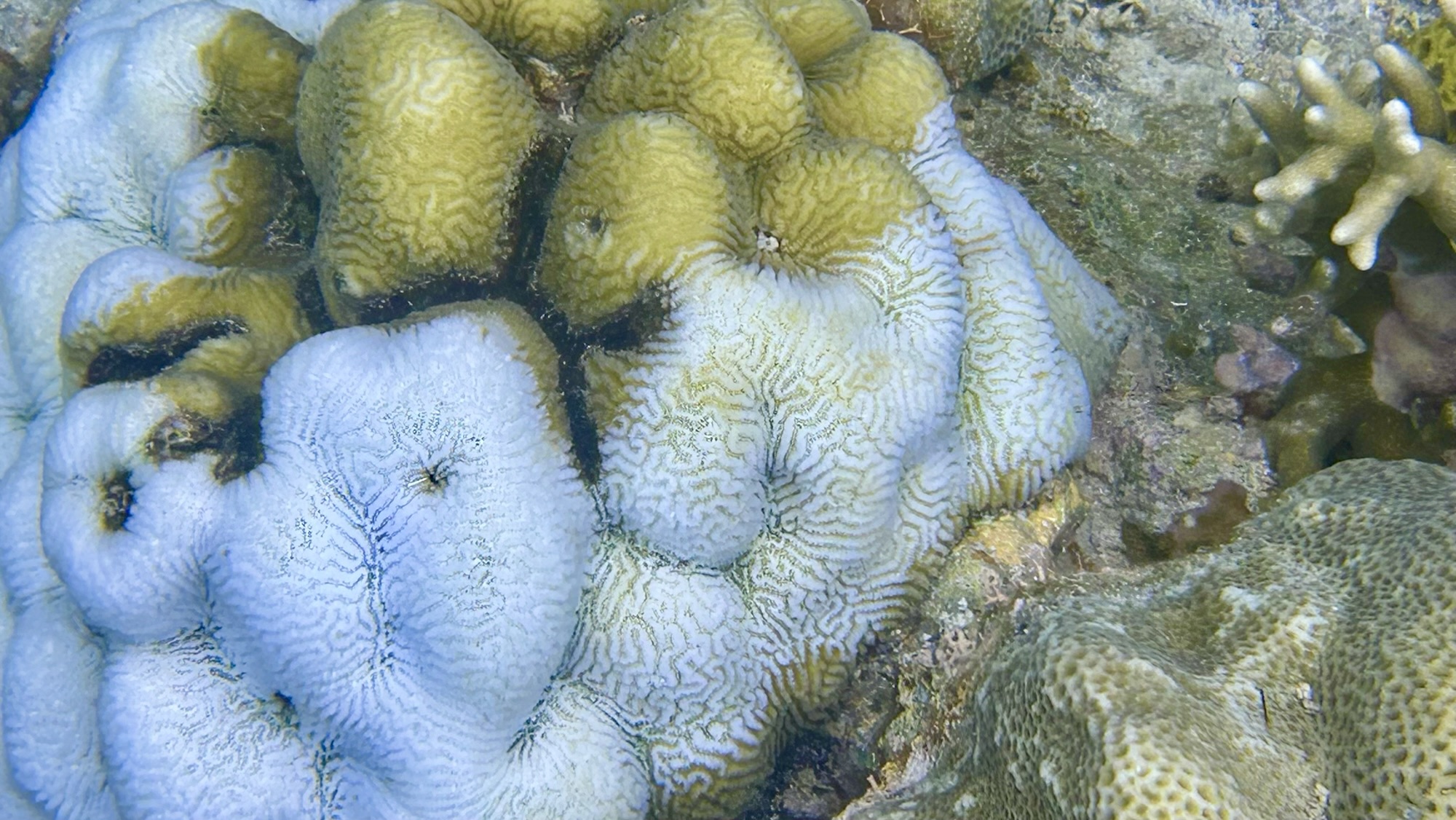
Coral bleaching occurs when elevated ocean surface temperatures disrupt the symbiotic partnership between a coral host and their endosymbiotic dinoflagellate algae (Symbiodiniaceae). This leads to expulsion of the symbiont partners and potential mortality (Glynn 1993; Brown 1997). More recent research recognizes that prior bleaching, some corals fluoresce, a physiological phenomenon associated with similar – thermal – stress causing corals to increase their production of photoprotective proteins, leading to a bright glowing effect. This usually occurs as onset or offset of coral bleaching. Acting like a sunscreen, this phenomenon is believed to help corals protect their symbiont algae from heat and cope with the increased internal light levels that occur during this stressful time (Salih et al. 2000 ; Gittins et al. 2015; Eyal et al. (2020). However while this might help for a time, fluorescing does not prevent coral bleaching when abnormal thermal conditions are prolonged or too intense (Roth and Deheyn, 2013). When thermal stress is prolonged or particularly severe, widespread coral bleaching will occur, with high mortality risks (Hughes et al. 2018b).
Mass coral bleaching is a relatively recent, though increasingly frequent, phenomenon related to global ocean warming, which has only been documented since the 1980s (Fankboner and Reid 1981; Glynn 1984; Lasker et al. 1984). More frequent and severe marine heatwaves have exacerbated these events up to creating Global-scale coral bleaching events (GCBEs) when impacting reefs across all tropical ocean basins within a common period (Spady et al. 2025). Four GCBEs have been documented so far, in 1998 (GCBE1) (Wilkinson 1999; Goreau et al. 2000), in 2010 (GCBE2) and 2014–2017 (GCBE3) and 2023-2025 (GCBE4) each more widespread and more severe than the prior (Eakin et al. 2019, 2026). NOAA reported approximately 84.4% of the world’s coral reefs impacted by the event during the latest GCBE4, the most extensive and intensive on record (Spady et al. 2025).
In 2026, El Niño, this phenomenon of periodic warming of the ocean, is back and expected to last until 2027 (NOAA, June 2026). Depending on its severity, NOAA already warned that its emergence could potentially bring a return of widespread coral bleaching. Fortunately nothing is certain yet and conditions vary per region. Nonetheless, one thing is sure: bleaching events are becoming more frequent, stronger with less intervals for recovery between them. And because of this global coral reef are critically threatened.
What impact did it had so far ?
It is difficult to assess global coral cover loss with certainty due to lack of historical of scientific data on coral reef cover prior to large-scale human interferences and pre-industrial era at such scale. Despite this, decline is certain. The latest global coral reef assessment by GCRMN and ICRI recorded a 9.5% relative decline in hard coral cover (1980-2009 to 2020-2024) with the largest single-year decline occurring in 2023–24 (8.9%) (Gonzáles-Rivero et al., GCRMN and ICRI, 2026)
How about in the Philippines?
In the Philippines we are prized with one of the largest area of coral reefs in the world with ~25,000 km² of coral reefs (Wong, 2022), third to Indonesia and Australia. Aside from the first GCBE1 in 1998 (Arceo et al, 2001) and the third GCBE in 2014-2017 which both produced severe impacts, reports of bleaching reported localized and relatively minor events until 2024.
During the 4th GCBE, we can remember with horror when the reefs of our dear Tubbataha National Park turned white (Tubbataha Management Office’s Ecosystem Research and Monitoring Report 2024), along with so many other reefs in the country (Rivera et al. 2024 ; Baria-Rodriguez, UPD MSI, 2025). Fortunately in Siquijor Island, coral thermal stress remained minor with bleaching rate under 1% at that time (CRCP, 2024, 2025). Since then, bleaching remained relatively low in the country (Philippine Coral Bleaching Watch). However this does not mean our reefs are safe.
Our experience in Siquijor
In Siquijor Island, although we have been blessed with dense and resilient reefs, over time we are seeing the signs of decline too. Years after years, threats are accumulating, from environmental to coastal development and human activities. Our reefs too, are getting overwhelmed. After the dry heat of summer, comes typhoon season, before the high touristic season and summer peaks again. All come as high sources of stress for the reefs.
How does all of it link with bleaching? The more local stressors, the less corals are able to cope with fast abnormal thermal change: exposure to additional stressors links with reduced thermal resilience overall (Carilli et al., 2009).
During our monitoring activities in San Juan a few months ago in Feb-April 2026, up to 16% of the hard coral colonies surveyed in 4 sites of the coastline of San Juan were actively manifesting signs of thermal stress. Majority of them via fluorescing but a small portion too via partial to full bleaching (4.3% on average) (CRCP, 2026). And the hot season was only starting then.
El Niño is already back
In June, El Niño, was confirmed to reach the Philippines and forecasted to aggravate throughout the year and early 2027. What does that mean for our corals? Potential high and long periods of thermal stress. While the severity remains to be confirmed, NOAA warned on September 10, that there is a 90% probability of turning into a very strong El Niño in Sept-December 2026. This was locally backed up by PAGASA.
How is this calculated and what does that means concretely?
- NOAA defines El Niño strength primarily by how far sea-surface temperature (SST) in the Niño-3.4 region rises above its normal value for that time of the year.
- The very strong category corresponds to a ≥ +2°C Relative Oceanic Niño Index (RONI) anomaly.
In August, the Niño-3.4 index was +1.8°C and NOAA forecasts a 75% chance that October–December 2026 reaches RONI ≥ +2.5°C, which would be an exceptionally strong event (NOAA September 2026).
In the Philippines, NOAA’s Coral Reef Watch data already issued a Warning alert for the Western Philippines with SST recorded at 30.6°C, about +1.4°C above climatology (NOAA alert). Fortunately this is not the case everywhere in the country. On August 24, Central Philippines were Siquijor is located was only +0.3°C. Although the region had accumulated 8.5°C-weeks of Degree Heating Weeks (DHW) because heat stress had persisted earlier, notably in April and June with +1.3°C and +1.4°C above climatology (based on the warmest month) respectively.
This partially explains our prior findings. And while it is reassuring to note that anomalies have been decreasing since locally, the long period of accumulated stress is likely to have weakened our reefs. With El Niño intensifying, their resilience will be tested once again. And so will be the reefs in the rest of the Philippines.
What can we do about this?
If we truly wish our corals well in the Philippines, is it essential to start acting accordingly and do our part to mitigate additional local stressors.
Local stressors come under the umbrella of low water quality and pollution, touch and impacts from human activities, low fish density and diversity, amongst the most common. Majority of these are linked to coastal activities and peak with high tourism when mitigating environmental strategies are not properly implemented. And unfortunately, they commonly are lacking.
What can you do to support coral reefs ?
- Vote and petition for proper environmental planning and strategies
- Be a responsible tourist who carefully select its destination and infrastructures to mitigate your impact when traveling and to avoid supporting businesses who avoid their environmental responsibilities.
- When entering the water, always use reef-safe substances and avoid direct contact with the reef and marine organisms.
- Be mindful of your diet (go plant-based) and environmental footprint overall.
- Educate yourself best as you can about corals and climate and inspire your peers to join a more environmentally mindful lifestyle
Interesting things to read on the topic
- CRCP publications on coral reef health in Siquijor here
- Coral Reef Alliance and ICRI’s campaign on coral bleaching here
- González-Rivero, M., Dallison,T., Wicquart, J., Brigdale, A., Logan, M., Fobert, E. K., Staub, F., and Planes, S. (eds.), 2026. Status of Coral Reefs of the World: 2025. Global Coral Reef Monitoring Network (GCRMN), International Coral Reef Initiative (ICRI). https://doi.org/10.59387/LFPR6347
- Spady, B.L., Skirving, W.J., De La Cour, J.L. et al.The 4th global coral bleaching event: ushering in an era of near-annual bleaching. Coral Reefs(2026). https://doi.org/10.1007/s00338-025-02810-x
- NOAA’s Coral Reef Watch