
CONSERVATION TRAINING / 1 day field course
Key Reef Substrate Indicators
Learn to recognize the sessile critters that make the foundation of coral reefs.
Reef substrate are often overlooked because they do not move much on the reef floor, are often small, and can appear crowded all next too each other. But these incredible organisms are just as fascinating as reef fishes, and much more diverse and mysterious. Learning to identify them underwater and understand their functions are skill that takes practice.
This one-day introductory course combines reef ecology, key groups taxonomy and identification and guided underwater observation, giving you the knowledge and practical skills to better understand and start recognizing the different organisms that create the substrate of coral reefs in their natural habitat.
You’ll learn about the major substrate groups found on coral reefs, their ecological roles, behaviors and identifying characteristics, before putting your knowledge into practice during guided reef sessions.
1 day · Classroom + reef fieldwork · Scuba or snorkeling · Small groups
What you’ll learn
By the end of this course, you will be able to:
- Understand coral reef ecology — learn how coral reefs are composed of interconnected and interdependent species forming a tight balance that maintain the whole community. Focus on the different organisms contributing to the substrate structure and functioning of coral reef ecosystems.
- Recognize key substrate — learn to identify 18 of the key groups of sessile organisms that compose reef substrate including cnideria (and exploring the main types, such as corals – Hard, soft -, anemones, zoanthids, corallimorphs, hydroid, etc.), sponges, tunicates, algae, clams, seagrass, etc. Explore their diversity within species.
- Understand their function and behaviors — discover how feeding, shelter, reproduction and social behavior influence where these organisms can be found, their abundance, roles on the reef, and how can they serve as key reef health indicators.
- Use visual identification skills — learn the key characteristics that help distinguish these 18 key substrate indicators underwater.
- Observe them in context — connect what you see underwater with the habitat and ecological role of each.
- Build your identification skills — practice recognizing reef substrate in their natural environment with guidance from an instructor.
The emphasis is on group-level identification (phylum or order depending on the type), allowing to cover a wider field of organisms and providing foundation for more advanced family-level identification for each group in the future.
Your day with CRCP
This field course is a 1 day session from 8am to 3.30pm with classroom session in the morning followed by in water session to complement the theory. Find below the approximate schedule:
- 08:00 — Classroom session
- Begin with an introduction of CRCP as an organization, the environmental work that we conduct & team on the field.
- Continue with the lecture on coral reef reef fish diversity, ecology and conservation.
- You’ll learn about 17 key reef substrate organisms (the major ones) found on coral reefs, their ecological functions, behaviors and the characteristics used to identify them.
- Learn about the signs we use to communicate about them underwater that we will use later on during the dive.
- 09:30 — Gear fitting
- Before heading into the water, let’s fit the gear (snorkeling or scuba diving) & make sure everyone is ready and comfortable.
- 10:00 — Guided reef session
- Put your new knowledge into practice during your first guided identification session of approximately an hour, either by scuba diving or snorkeling.
- Your instructor will help you observe the reef and its substrate organisms in their natural habitat while developing your ability to recognize and understand what you are seeing.
- 11:30 — Break and debriefing
- Warm up, drink some water, refuel with with fresh fruits / snacks while debriefing with your guide what you have seen in the water and what to expect next.
- 12:00 — Second guided reef session
- Further your knowledge and gain confidence in your skills during a second guided identification session.
- Your instructor will keep on showing you key substrate indicators while developing your ability to identify them. She might as well quiz you on substrates already seen during the first session to help you gain confidence and lock your newly acquired skills.
- 13:15 — Heading back to base + washing up
- Let us drive back to base, drop and rinse our gear
- 13:45 — Lunch
- Enjoy warming up with a plant-based lunch and snacks back at base made by our chef.
- 15:00 — Debrief & Closing Remarks
- Debrief with your instructor about what you have learned during the day between theory to underwater sessions, how confident you are with your skills and what are the next steps to keep building on this. Discuss what are the key takeaways from today and how to use them back home to support your own conservation journey.
- 15:30 — Course end
- The exact schedule and time may vary depending on the course date and field conditions. We will confirm the final schedule when you book.
Choose your format
The course is available as a scuba diving or snorkeling field course.

Scuba diving*
(Recommended)
Scuba allows you to spend more time exploring the reef and observing organisms at different depths.
The scuba format includes two guided identification dives with an instructor.
Requirements
- Valid Open Water certification or equivalent qualification (PADI, SSI, RAID, CMAS or equivalent).
- Minimum of 15 logged dives, including at least one dive during the current year; or buoyancy training with CRCP during the current year.
- You must be healthy and fit for shore diving.
- Good buoyancy control and comfort in the water are essential.
PHP 4,500

Snorkeling
(Available)
The snorkeling format provides a surface-based alternative for participants who do not scuba dive.
You will take part in guided snorkeling sessions focused on observing and identifying reef organisms in their natural habitat. Siquijor hosts shallow reefs and clear water which are great for snorkeling (upon favorable weather conditions)
Requirements
- Ability to swim comfortably without swimming aids.
- Previous experience using a mask, snorkel and fins.
- Good comfort in the water.
PHP 3,000
Why are our water requirements strict?
During this course, we work closely with small and fragile marine organisms. Good water skills, buoyancy control, precision and careful movement are therefore important—not only for your own safety, but also to minimize the risk of damaging the reef or disturbing marine life.
If you do not yet meet the requirements, contact us. Depending on your experience, we may be able to organize refresher training or additional preparation before the course.
What is included?
Your course fee includes:
- Classroom learning – One classroom session covering coral reef ecology, biodiversity and conservation.
- Guided field sessions – Two identification-focused reef sessions with a CRCP instructor.
- Equipment – Scuba or snorkeling equipment and applicable marine fees.
- Lunch & snacks – Plant-based lunch and snacks are included. Vegetarian and vegan options are available.
Course fee
| Format | Fee |
|---|---|
| Scuba diving | PHP 4,500 |
| Snorkeling | PHP 3,000 |
| Online – Theory only | PHP 1,500 |
A 20% deposit is required at the time of booking to secure your spot.
Filipino participants
Filipino participants receive an automatic 20% discount as a way to promote local participation. Simply let us know when you enquire so we can apply the discount.
CALENDAR /
Upcoming dates
We run this course in small groups to allow participants to receive close guidance from our instructors.
In 2026
- September 23, 2026
- October 21, 2026
- November 25, 2026
In 2027
- February 17, 2027
- March 17, 2027
- April 21, 2027
Additional dates may occasionally be available, particularly for online participants. Contact us if you have a preferred date or need another option.
Small groups · Advance booking recommended
Places are limited and courses can fill quickly. Bookings close one month before each scheduled course date.
Learn from conservation practitioners
This course is delivered by our environmental NGO Coral Reef & Rainforest Conservation Project (CRCP), as a mean to promote environmental literacy and uplift the community of marine lovers in the Philippines with environmental skills and good practices.
Our training programs connect education with real conservation work. Rather than learning about coral reefs only from a textbook, participants are introduced to the ecological concepts, observation skills and conservation approaches used in the field.
You learn in the environment we are working to protect.
Your training support our conservation efforts
For CRCP, education is a critical part of our conservation work.
Through our learnwithCRCP programs, we share knowledge, develop practical conservation skills and encourage individuals to become more active stewards of the natural environment. Through this, we share our passion. Participation in our training programs also helps support and fund CRCP’s wider research, monitoring and conservation activities. It as well as a source of funding for our research & conservation efforts. By joining a CRCP course, you are not only investing in your own knowledge, you are helping us continue our work to better understand and protect our local ecosystems.
Learn. Explore. Understand. Protect.
FAQ
Is this course suitable for beginners?
Yes. The course is designed as an introduction to coral reef ecosystems and key substrate indicators and does not require previous knowledge of marine biology. For the scuba format, however, participants must meet the diving requirements above.
Do I need to be a diver?
No. You can participate through the snorkeling format.
We also offer an online theory-only option for people who cannot participate in the field activities.
Is scuba diving recommended?
Yes. Scuba allows you to spend more time observing the reef and provides greater access to the underwater environment. However, snorkeling participants receive the same core ecological and conservation theory. While Siquijor hosts beautiful shallow reef that can be great for snorkeling, their access is however more variable depending to weather conditions (waves, wind and visibility). Allowing to go beyond the surface, scuba diving is less subject to these variables.
What happens if I don’t meet the scuba requirements?
Contact us before booking. Depending on your experience, we may be able to organize refresher or buoyancy training with CRCP before the course.
Can i come alone or is this for groups only?
You can come alone absolutely, most of our participants do. But if you prefer joining with your friend or partner, that works too. Our sessions are organized in small groups only so that everyone meet and quickly feels comfortable.
What should I bring?
For field sessions, bring your swimwear, towel, reef-safe personal sun protection, drinking water and anything else you normally require for a day outdoors.
We will provide the diving or snorkeling equipment included in the course. If you already have a mask, snorkel and personal fins, bring them in for extra comfort (it’s always nicer in your own).
Can I combine this course with other CRCP training?
Yes. If you are interested in combining this field course with other ecology or practical conservation training this is possible, contact us and tell us about your goals.
We can discuss how different courses could be combined into a broader learning experience.
Can the course be arranged on a different date?
Yes. Classes are available on request, subject to instructor and field availability. We recommend contacting us several weeks in advance.
Where is the course conducted ?
We host this field course in our base in Siquijor Island. Regarding, the dive / snorkeling site, we pick the site depending on season and weather for the most favorable conditions.
Ready?
Schedule your training with us
Our other conservation training programs
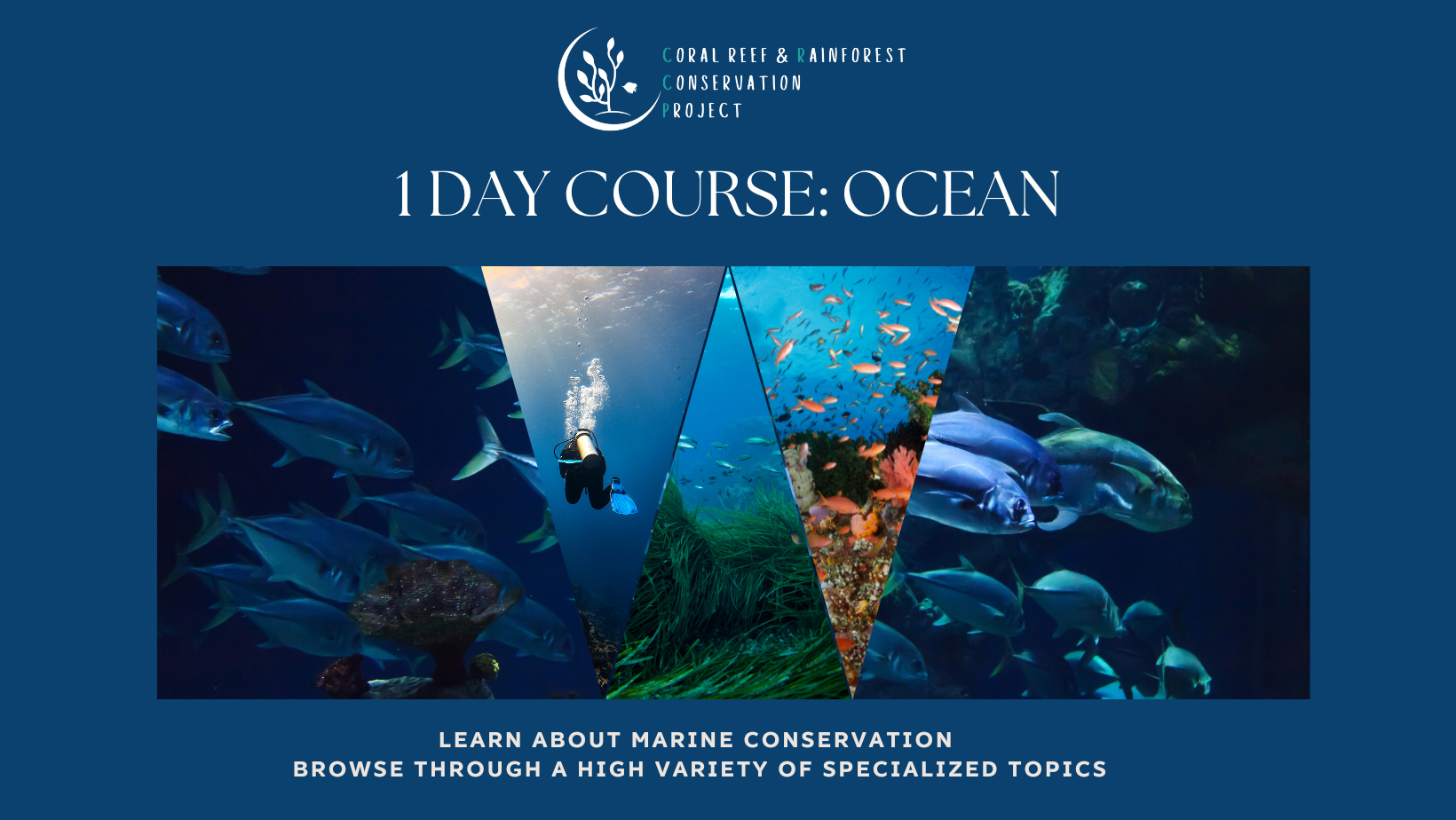
1 DAY CLASS:
MARINE OR TERRESTRIAL
Would you like to learn about marine or terrestrial ecosystems but you only have 1 day to spare ? This is for you. Pick and choose your preferred topic and come for an adventure. Each class is composed of 1 ecology and conservation lecture followed by field activity guided by one of our local expert. All levels welcomed!

1 WEEK PROGRAMS
Come immerse in environmental conservation for a 5 days / 6 nights with a team of experts on the field. Take a break from daily life, reconnect with nature, immerse in forests and pristine coral reefs and learn about how to protect them. We offer various types of 1 week programs, from broad to specialized.

LONGTERM & PROFESSIONAL COURSES (4wks min)
Are you interested in growing skills to take a bigger step from your daily life and actually help local scientific research and conservation work? Field work require skills but everything can be learned with time and efforts. If this is you, we offer long term development and mentorship programs.