
Why is it critical to monitor our marine resources?
DID YOU KNOW ? /
Philippines, home to one of the highest amount of Marine Protected Areas.
The Philippines is home to one of the highest amount of Marine Protected Areas (MPAs) in Southeast Asia. While famous marine parks or NIPAS such as Tubbataha reef are managed at a national level with the ambition to protect and enhance biodiversity, most MPAs are locally-managed (LMMPAs). Understanding the close relationship Filipinos have with the ocean and the dependance coastal communities have on its resources, LMMPAs are established as a tool to both care for marine ecosystems but mostly protect and enhance food security for the people. Through regulating human activities and pressures in set areas and insuring the preservation of healthy, biodiverse key ecosystems such as coral reefs, seagrass and mangroves; they are part of a national strategy to balance the impacts of fishing practices and other human activities to ensure sustainability of the coastal resources.

THE ISSUE /
While this sounds like great news, it is important to understand that there is a great disparity in results and effectiveness of these LMMPAs in the country and an overwhelming majority are not reaching their target goals. Facing the general decline of coral reefs ecosystems, preserving the marine biodiversity of the Philippines is critical. Marine monitoring of the underwater resources is key to protecting them, creating a baseline reference of their state of health and allowing to assess priority areas, track effectiveness of conservation efforts and offer necessary support where it is needed.
Despite being globally acclaimed and recognized for its marine biodiversity, access to updated, reliable, standardized data on the ecology, diversity, health and resilience of coral reefs in the Philippines is more complex than it looks and data remains sparse. The archipelago is big, technical and financial resources lacking in many areas posing challenges.
WHAT WE DO
OUR WORK /
Collecting data on reef health & resilience
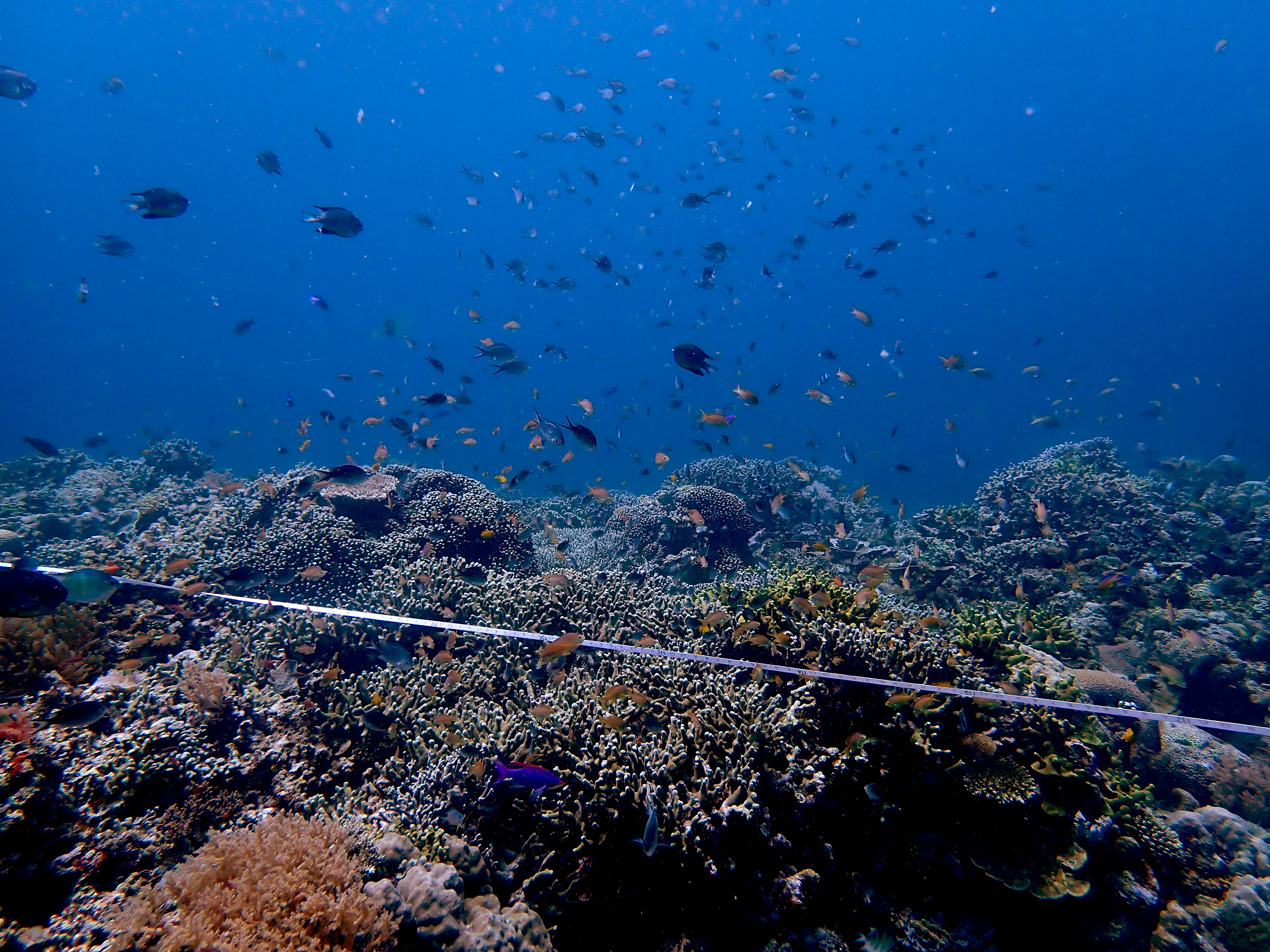
Our team of marine biologists, researchers and experts is dispatched on the field to conduct monitoring of the marine biodiversity of coral reefs and adjacent ecosystems in our project sites. Partnering with LGUs, POs and communities members, many of our research sites are located in Locally Managed Marine Protected Areas to assess their effectiveness, track change over time and identify possible areas of improvement needed. Our goal is to support their work by offering technical and strategic support through this, as well as providing them visibility and tools to access additional needed resources. Some of our research sites are as well located in non protected areas, in order to assess current state of the local reefs despite the ongoing pressures.


What are our research and coral reef monitoring focused about ?
We study coral reef ecology, health and resilience status, with focus on substrate composition, diversity and abundance of fish populations and benthic species. We are tracking coral health and response to stressors (such as pollution, climate change, fishing activities and other human / tourists interactions, etc.). We study resilience to those pressures and the effectiveness of conservation action in minimizing them.
Our impact in numbers.
37 hectares of reef
under active biophysical monitoring and conservation management
283 surveys c
onducted
to assess reef health and resilience in Siquijor Island
6,507 corals studied
looking at species, growth form, health and resilience
107,225 reef fish analyzed
looking at species, size, maturity levels, behavior
4 scientific reports published
since 2023 and more ongoing

More of a visual person? Visit our open data access platform.
We know that reading scientific and management reports are not for everyone. If you just want a quick peak into our coral monitoring results and the data that we collect, we created an open access data platform.
You would like to help us organize an expedition to assess reefs & / or train professional divers in your local area ?
Our aim is to increase our data collection efforts to reach wider parts of the Philippines, we are – however limited by resources and manpower and can only do so much at the same time. If you have the means to help us expand our monitoring by helping us organize an expedition in your local area, we’d love the support. If you are working in this field and looking for support in training a local professional team to conduct monitoring, we’d be happy to help and partner. Let us know!

